How to Choose a Parking Management System
How to Choose a Parking Management System: A Practical Guide for Cities and Businesses
If you manage a parking facility — whether it’s a city lot, a hotel car park, or a large shopping center — you already know that poor visibility into occupancy creates real problems: frustrated visitors circling for spaces, revenue lost to unpaid stays, and no data to support better decisions. The right parking management system changes all of this.
But with a growing number of solutions on the market, how do you choose the right one? Here is a practical guide to the key criteria.
1. Does It Work with Your Existing Infrastructure?
One of the biggest hidden costs of adopting a new parking system is hardware replacement. Many traditional solutions require proprietary sensors embedded in the ground or specialized camera hardware, making deployment expensive and disruptive.
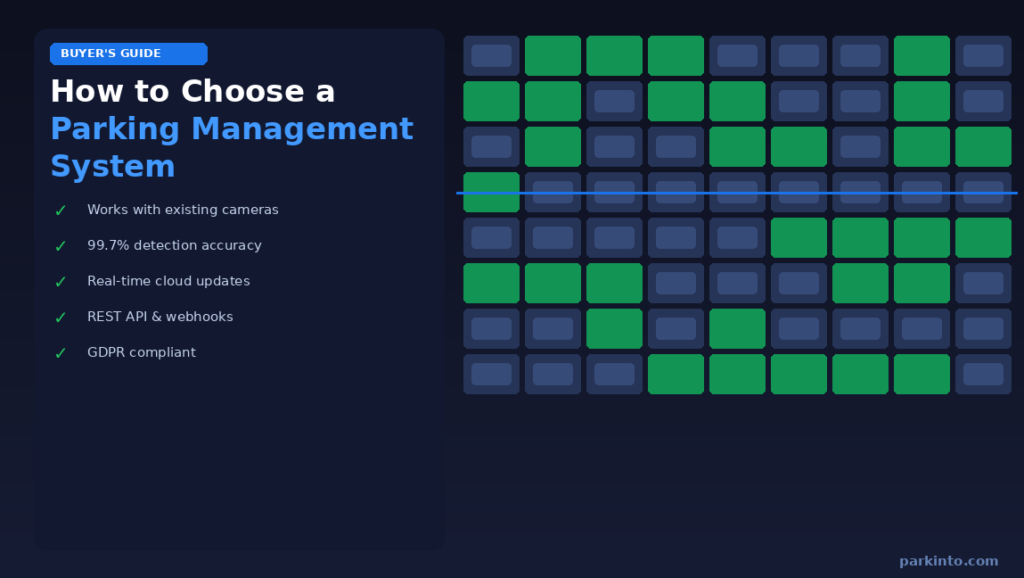
Look for a system that works with the IP cameras you already have installed. A camera-based AI solution like Parkinto can use your existing surveillance cameras — or an off-the-shelf IP camera of your choice — to start detecting occupancy without any ground works or infrastructure changes.
2. How Accurate Is the Detection?
Accuracy is everything in parking management. An occupancy display that is wrong 5% of the time will erode trust with drivers almost immediately. When evaluating a system, ask for independently verified accuracy data.
The Czech Technical University measured Parkinto’s accuracy at 99.4% two years ago. With improvements since then, the system now consistently operates at approximately 99.7%. That level of precision means drivers and operators can trust the data they see.
3. Is It Cloud-Based with Real-Time Updates?
A parking management system that requires on-site servers or updates every few minutes is no longer competitive. The modern standard is cloud-based infrastructure with near-instant data availability. This means you can access occupancy data from any device, anywhere, and your parking signs and mobile apps always reflect the current state of the lot.
Check how frequently the system updates occupancy status. Parkinto, for example, captures and analyzes camera images every 30 seconds — fast enough for real-world operational use.
4. Does It Offer API Integration?
Your parking system should not be an island. Whether you need to feed data to electronic roadside signs, a city mobility platform, a hotel booking system, or a custom mobile app, a well-documented API is essential.
Before committing to any platform, verify that it offers a REST API for querying occupancy data and webhook support for real-time event notifications. These two features alone determine how smoothly the system fits into your broader digital infrastructure.
5. What Happens After Installation?
Technical support and service availability matter far more than the initial sales experience. Ask what support hours are available, whether there is dedicated account management, and how software updates are handled.
A SaaS-based solution is generally preferable here — updates are delivered automatically, and you are never stuck running outdated software. Look for a vendor who has active deployments in your region and can provide local installation partners.
The Bottom Line
The best parking management system is one that accurately detects occupancy, integrates with your existing infrastructure, provides real-time cloud-based data, and offers robust API connectivity — all at a transparent, predictable cost. Evaluate vendors against these criteria and, where possible, ask for a pilot deployment before committing.
Parkinto offers a 2-week free trial with no long-term commitment. It is a practical way to see whether the system fits your environment before making a decision.