5 Signs Your Parking Lot or Marina Needs an AI Occupancy Detection System
Parking management problems rarely announce themselves loudly. They tend to surface gradually — as complaints from visitors, unexplained revenue shortfalls, or staff spending hours on tasks that should take minutes. If any of the following signs sound familiar, it may be time to look at AI-powered occupancy detection.
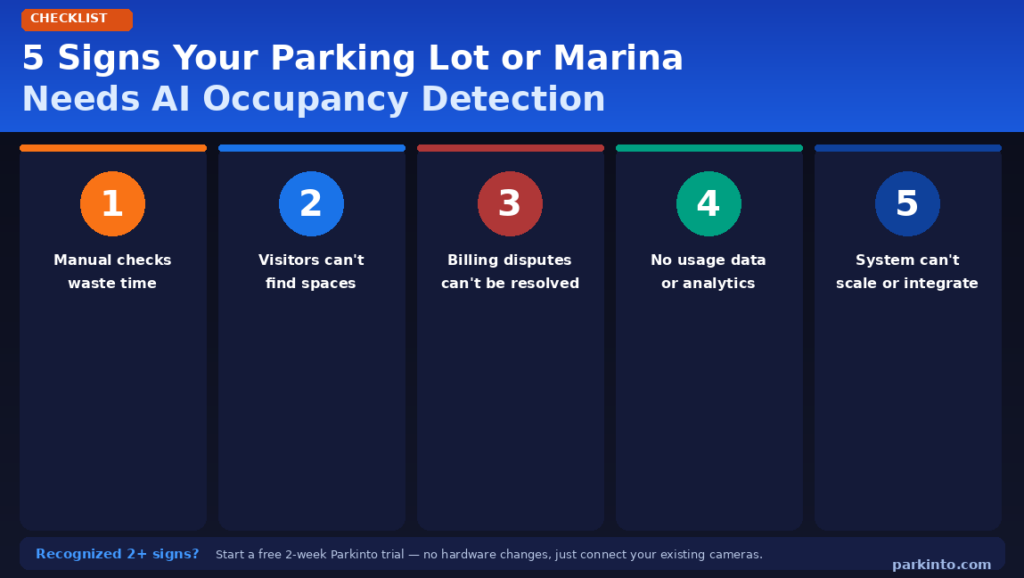
1. Your Staff Spends Significant Time on Manual Checks
If someone on your team regularly walks the lot or marina to count available spaces, verify occupancy, or check whether boats have departed on time, that is a strong signal that automation is overdue. Manual checks are time-consuming, prone to error, and provide only a snapshot of a constantly changing situation.
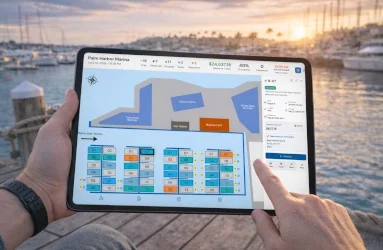
An AI occupancy detection system eliminates the need for routine manual checks entirely. The system monitors every space continuously and makes the current state available in real time through a web portal and API — without anyone having to walk the lot.
2. Visitors Complain About Not Finding Available Spaces
When drivers or skippers cannot quickly find an open space, frustration follows. For a city parking lot, it adds to traffic congestion as people circle. For a marina, arriving sailors may be left idling in the harbor waiting for guidance.
A smart parking or marina system with real-time occupancy display — on electronic signs, a mobile app, or GPS navigation — solves this problem directly. Drivers are guided to available spaces before they even enter the lot; skippers can check berth availability from the water.
3. You Have Billing Disputes You Cannot Resolve Definitively
Billing disputes — a driver claiming they only stayed an hour, a boat owner insisting a berth was vacated before checkout — are difficult to resolve without objective occupancy records. When billing is based on tickets or manual notes, there is no ground truth to refer to.
AI occupancy detection creates a timestamped record of every occupancy event. That data makes disputes easy to resolve and, more importantly, reduces their frequency — because both parties know the system is tracking the facts.
4. You Have No Data on How Your Lot or Marina Is Actually Used
Many parking operators and marina managers are essentially flying blind. They know roughly how full the facility tends to be at peak times, but they have no hourly breakdown, no seasonal trend data, and no way to measure the impact of pricing changes.
Without data, decisions about pricing, capacity, staffing, and expansion are educated guesses. Parkinto’s statistics module provides continuous occupancy data broken down by hour and spot, giving operators the insight they need to make decisions that actually improve performance.
5. Your Current System Cannot Scale or Integrate with Other Tools
If adding a new section to your parking lot means installing new sensors at significant cost, or if your parking data lives in a silo disconnected from your management systems, your current setup is already limiting you.
A camera-based AI system like Parkinto scales naturally — add a camera, configure the new spaces in the portal, and the system begins monitoring. With a documented REST API and webhook support, occupancy data feeds directly into electronic signs, mobile apps, city mobility platforms, or any custom system you already use.
Recognizing the Signs Is the First Step
None of these problems are unique to a particular type of facility. City lots, hotel car parks, shopping mall garages, office buildings, marinas, and ports all face the same core challenge: managing a physical resource with limited visibility and manual processes that do not scale.
If two or more of these signs apply to your situation, a free 2-week trial of Parkinto is the fastest way to understand what AI occupancy detection can do for your operation. No specialized hardware required — just point a camera and let the AI do the rest.